
Editors Club of India Announces Legal Wing — A Historic Step Towards Media Freedom and Legal Protection
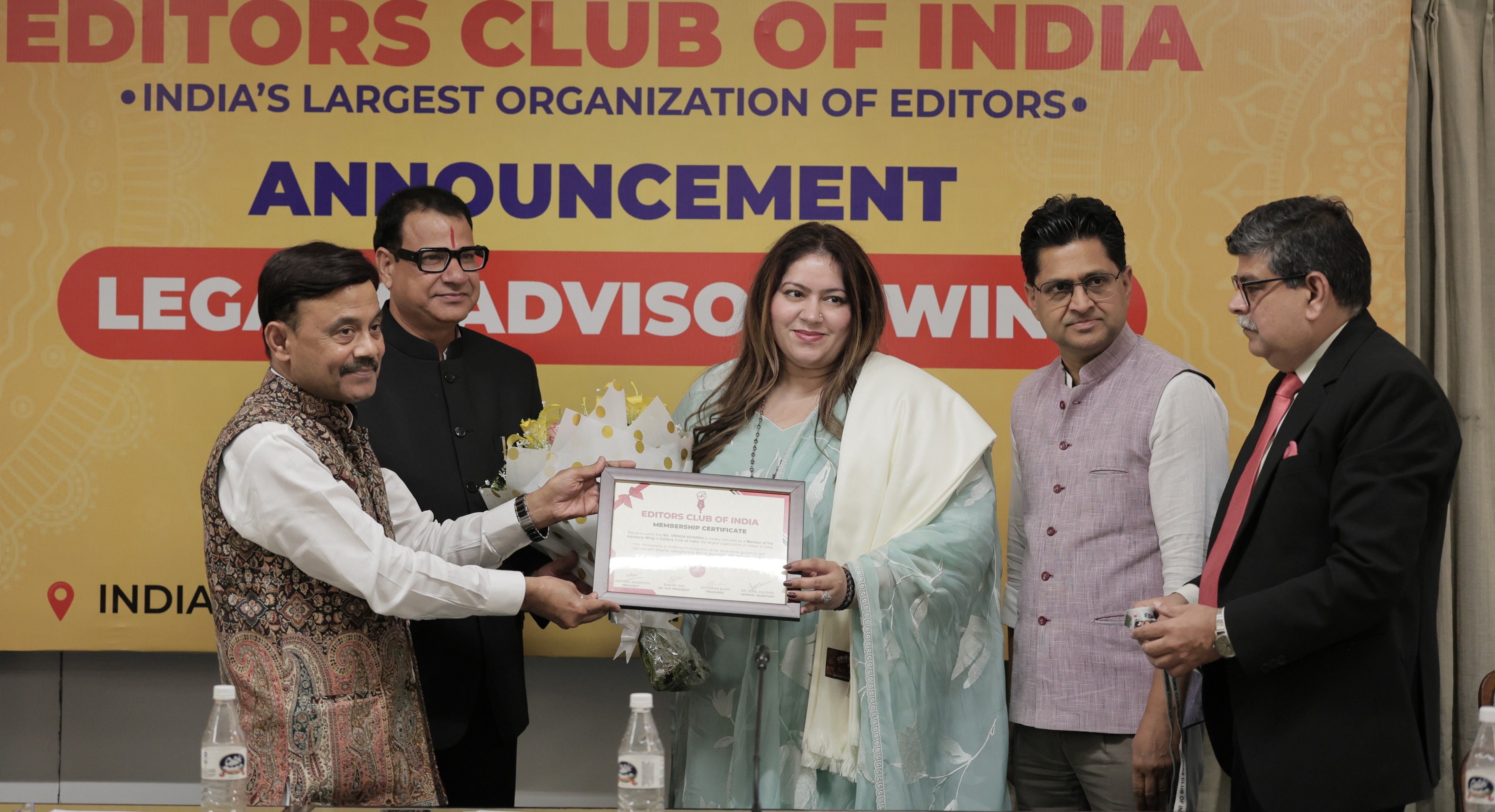
New Delhi: In a significant and forward-looking initiative aimed at upholding the dignity of journalism, ensuring editorial independence, and providing strong legal support to media professionals, the Editors Club of India has formally announced the launch of its Legal Wing. The announcement was made by National President Amitabh Agnihotri during a dignified program held at the India International Centre, New Delhi.
The event witnessed the presence of senior editors, journalists, legal experts, and distinguished personalities from the social sector. The Legal Wing was introduced as a robust institutional framework designed to provide protection, guidance, and judicial assistance to journalists and media organizations facing legal challenges.
Senior Supreme Court Advocates Take Charge
The newly formed Legal Wing includes experienced and eminent advocates from the Supreme Court of India, specializing in constitutional, criminal, civil, and freedom of expression-related matters concerning the media.
Key members of the Legal Wing include:
- Advocate Lalit Mohini Bhat
- Advocate Ashwani Kumar Dubey
- Advocate Alok Kumar
- Advocate Pramod Kumar
- Advocate Sandeep Kumar Dubey
- Advocate Deepak Kumar Jena
- Advocate Mithilesh Kumar Singh
- Advocate Mukta Sharma
- Advocate Nilanjan Chatterjee
- Advocate Pragya Priya
- Advocate Kuldeep Singh Parihar
- Advocate Akhilesh Singh
- Advocate Anil Kumar Srivastava
- and Advocate Amit Sharma, among others.
Welcoming the advocates, the National President stated that this team is not merely a formal structure but will function as a “protective shield” for the media fraternity.
Key Functions of the Legal Wing
During the event, the scope and responsibilities of the Legal Wing were elaborated. In today’s environment, journalists often face legal challenges such as defamation cases, criminal proceedings, disputes over digital content, issues related to press freedom, and administrative pressures. The need for a structured and expert legal platform has long been felt.
The key functions of the Legal Wing will include:
-
Providing legal consultation to journalists and editors
-
Assisting in matters related to press freedom and freedom of expression
-
Offering legal support in cases of media trials, false cases, and harassment
-
Organizing workshops and training on media laws
-
Guiding on legal frameworks related to digital media and emerging technologies
-
Filing Public Interest Litigations (PILs) when required
-
Submitting policy recommendations to the government on journalist safety and rights
Address by National President Amitabh Agnihotri
In his presidential address, Amitabh Agnihotri stated that while the present era offers immense opportunities for journalism, it is equally filled with challenges. He emphasized that independent journalism is the soul of democracy, but when journalists are burdened by legal pressures, democratic dialogue weakens.
He said:
“The Editors Club of India is not just an organization but a movement to protect editorial values. The establishment of the Legal Wing is meant to assure journalists that those who speak and report the truth are not alone. Whenever any journalist faces unjust action, this wing will stand firmly in their support.”
He further added that ensuring a media environment free from fear and pressure is a matter of national interest, and this wing will strengthen that fight at the judicial level.
Statement by National General Secretary Dr. Sunil Kaushik
Addressing the gathering, National General Secretary Dr. Sunil Kaushik described the Legal Wing as the “backbone” of the organization. He noted that journalism today is no longer limited to reporting news; legal awareness has become equally essential.
He said:
“Many journalists in the country face legal troubles simply due to lack of awareness. Our aim is not to provide help after the struggle, but to ensure preventive protection and proper guidance from the beginning. The Legal Wing will empower journalists with legal understanding and strength.”
Dr. Kaushik also highlighted that the Editors Club of India is working toward becoming a voice for media rights not just nationally but internationally, and this wing will accelerate that mission. He expressed gratitude to all appointed advocates, stating that their expertise will be invaluable to the journalistic community.
The program also emphasized that the Legal Wing will act as a constructive bridge between the media and the judicial system, ensuring not only legal protection for journalists but also promoting responsible and sensitive journalism.
Experts present at the event observed that disputes related to digital media, social media content, and cyber laws are expected to rise significantly in the coming years, making such institutional initiatives critically important.
Future Plans
The Editors Club of India announced that legal assistance cells will soon be established across various states. Additionally, national seminars on media law, legal awareness camps, and documentation related to journalist safety will be developed.
The program concluded with a collective resolve toward national interest, fair journalism, and legal empowerment.